
‘This feels like a nightmare’
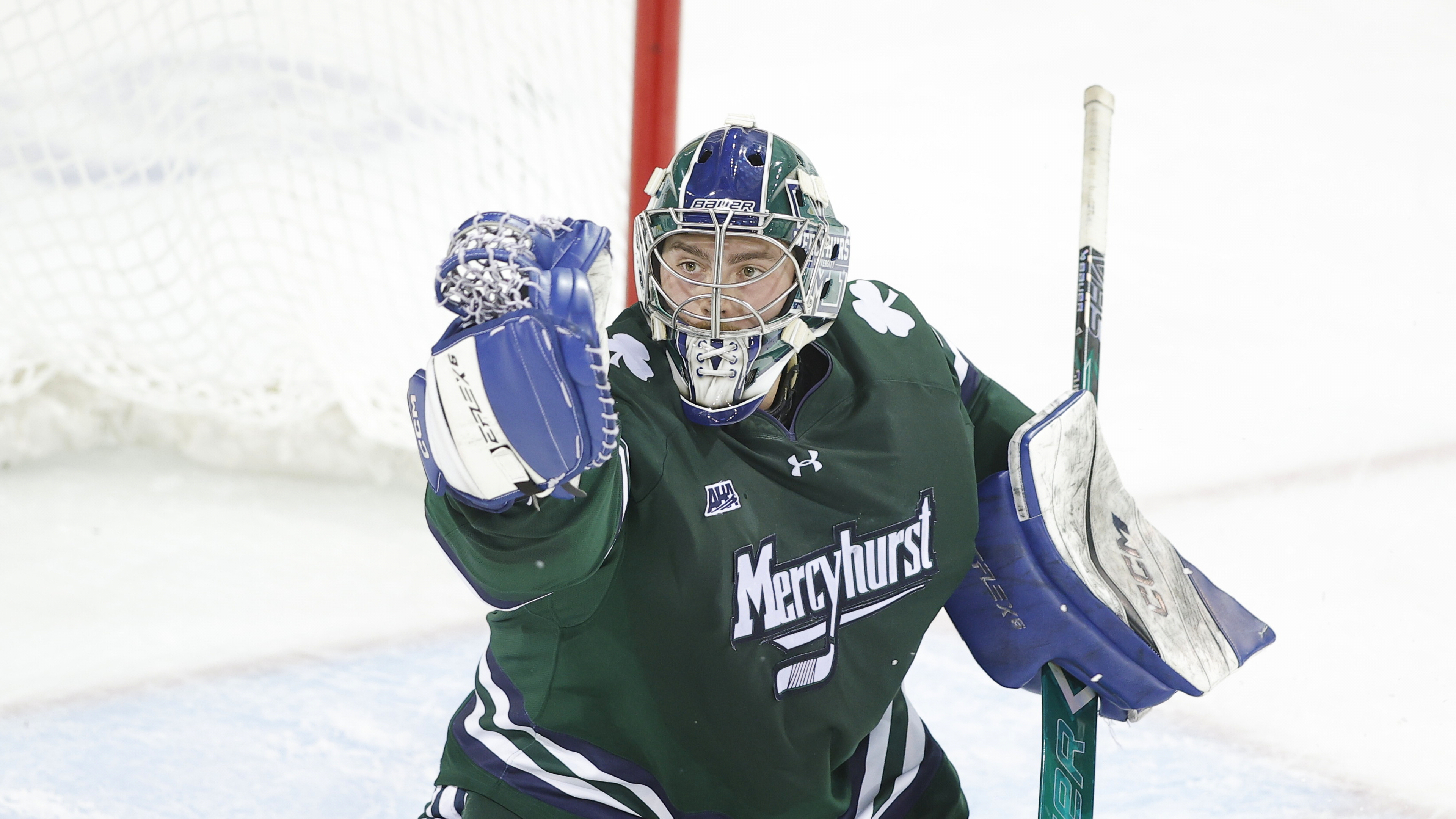
Tyler DesRochers was in the hospital when he got the news from his father that Mercyhurst University was slashing its men’s hockey team.
His teammate, Simon Bucheler, was in the team locker room for an urgent meeting when he received a text with a screenshot of the announcement.
And a third member of the team who was in the meeting, Sean James, saw a campus-wide email on his phone from Mercyhurst President Kathleen Getz about it.
Then, athletic director Joe Spano and Laura Zirkle, vice president of student life and athletics, told them in person.
“We were devastated,” James said.
“This feels like a nightmare,” Bucheler said.
“I would imagine that no one’s going to want to stay,” DesRochers said.
Mercyhurst, a 100-year-old private school of about 2,600 students in Erie, announced March 27 that the just-completed 2025-26 season would be the last for the men’s hockey team.
In a corresponding move, the university also discontinued eight majors in fields ranging from sociology to art therapy.
“These were thoughtful and consequential decisions,” Getz said in a statement. “They reflect our responsibility to ensure Mercyhurst remains strong, responsive, and focused on providing students with the opportunities and experiences that will prepare them for success.”
The university said it would honor scholarships for any players who remain at Mercyhurst and assist those who choose to transfer.
As of Thursday morning, 22 players on the roster with eligibility remaining had entered the NCAA’s transfer portal.
Three had committed to new schools.
Emily Blount, Mercyhurst’s director of athletic communications, declined further comment.
Alumni rally in support
As word began to spread of the decision, a group of alumni and supporters launched a petition campaign in the hopes of persuading the administration to “simply pause, not eliminate” the program.
Gary Bowles of Chippewa Township in Beaver County, a former Mercyhurst hockey player who graduated in 1991, said the announcement felt like a “gut punch.”
“There was no inkling, no indication at all that this was in the works,” Bowles said. “There was no notice sent out to any of us alumni to say, ‘Hey, you know we’re having financial difficulties with the team. Can you guys get together, raise some money?’ There was nothing like that.”
There was an appeal for money, but it didn’t say anything about the program facing an existential crisis. It came as part of the university-wide Giving Day on March 25, two days before the ax fell.
“The strides our team made this year leave me very excited about the future of the program,” wrote senior forward Barrett Brooks in an email to supporters sent by the university and obtained by the Post-Gazette. “By establishing new standards, innovative leadership, and a strong, cohesive culture, there is a clear direction for continued growth and success.”
Six donors gave a combined $465 earmarked for the men’s hockey team, according to information on Mercyhurst’s website.
The sport garnering the most support was, by far, women’s lacrosse, with 470 donors giving a combined $40,858.
The timing of Giving Day and the announcement of the program’s elimination rankled Bowles.
“They did this and still allowed people to donate,” he said.
Organizers are touting the success of the online petition, which they say has been signed by more than 3,300 people. Of those, 40% would consider donating to Mercyhurst hockey, organizers report, and 90% of alumni who signed the petition said they would halt donations to the school if the decision was not reconsidered.
More than 1,000 left comments in support of preserving the program that petition organizers said would be forwarded to the university’s administration and Board of Trustees.
Mercyhurst provided a statement to TV station WIVB in Buffalo that read: “We understand that this decision has prompted strong reactions from alumni and others who care deeply about Mercyhurst hockey. … We appreciate the continued engagement of our alumni community and their connection to Mercyhurst.”
Jason Staley of Mt. Lebanon is a former Mercyhurst football player who graduated in 2005 and provides planned giving to both the football team and the university. He believes Mercyhurst should reconsider its decision in light of the “groundswell of support” borne out by the petition, but he has no plans to stop donating.
“I love, love the school. My commitment will always be to the school,” he said. “I’m not going to stop giving to a place that has given me everything.”
Hockey wasn’t his sport, but he fondly remembers cheering for the Lakers.
“To go to hockey games was part of the social fabric of Mercyhurst,” he said.
Challenges lie ahead
In a Frequently Asked Questions section of its website, the university, in explaining its decision, said, “Sustaining an intercollegiate athletics program requires consistent, long-term resources rather than one-time funding.”
There is precedent, however, for what the group of alumni and supporters are attempting to do.
Robert Morris in May 2021 announced it was cutting both its men’s and women’s hockey teams. Like Mercyhurst, the Colonial men were members of the Atlantic Hockey America conference.
And, like the Mercyhurst alumni, a group of Robert Morris alumni rallied in an attempt to save both programs.
They publicized the campaign, raised money, formed a foundation and hired a lawyer. Soon, the university was working with the foundation to raise the $1.4 million needed to reinstate the programs.
There were stumbling blocks and delays, as the Post-Gazette reported, but by mid-December 2021, there was $1.5 million in the bank and another $1 million in future pledges.
Ultimately, the Colonials were back on the ice for the 2023-24 season, giving them time to rebuild staff and assemble competitive rosters.
Bowles said he has reached out to the Colonial Hockey Foundation “to try to just pick somebody’s brain there to get information on what worked for them, what didn’t work.”
What’s next for players?
All three of the Mercyhurst players who spoke with the Post-Gazette are juniors.
“Obviously, it’s a little tougher only having one year of eligibility,” James said, “but it’s tough for everyone.”
DesRochers, who said he spent five nights in the hospital after suffering a workout-related injury, said he’s not sure what his future holds.
“I just feel, you know, kind of lost,” he said, “and not having much of a purpose being here.”
He didn’t get a chance to immediately talk with his teammates because they went on Easter break the week after the announcement, but he imagines they feel the way he does.
“That’s the reason why we came here, right? To play Division I hockey,” DesRochers said.
The Lakers struggled to a 6-28-3 record and a last-place finish in the conference in 2025-26, but James said he was upbeat as the season concluded.
“We thought we were moving in the right direction,” he said.
The team was even embarking on a new era. Longtime coach Rick Gotkin was retiring, but assistant Tom Peffall had been named “head coach in waiting” a year ago.
James said the university emphasized the benefit of being able to enter the portal two and a half weeks early because of their special circumstances, but he questioned the true benefit.
“That was their big favor they did for us,” James said. “But really that doesn’t do anything at all, because every other school is going to wait for the regular portal to open to see who’s in there.”
Staley was sympathetic to the hard decisions he says administrators at small schools have to make, but said the very things he learned at Mercyhurst could be the difference in whether the program dies or survives.
“Mercyhurst taught us to be problem-solvers, to be innovators, to take a set of problems that might seem uphill,” he said. “But if you feel like it’s the right thing to do, take on the fight.”