
Schools shared debunked vaccine claims
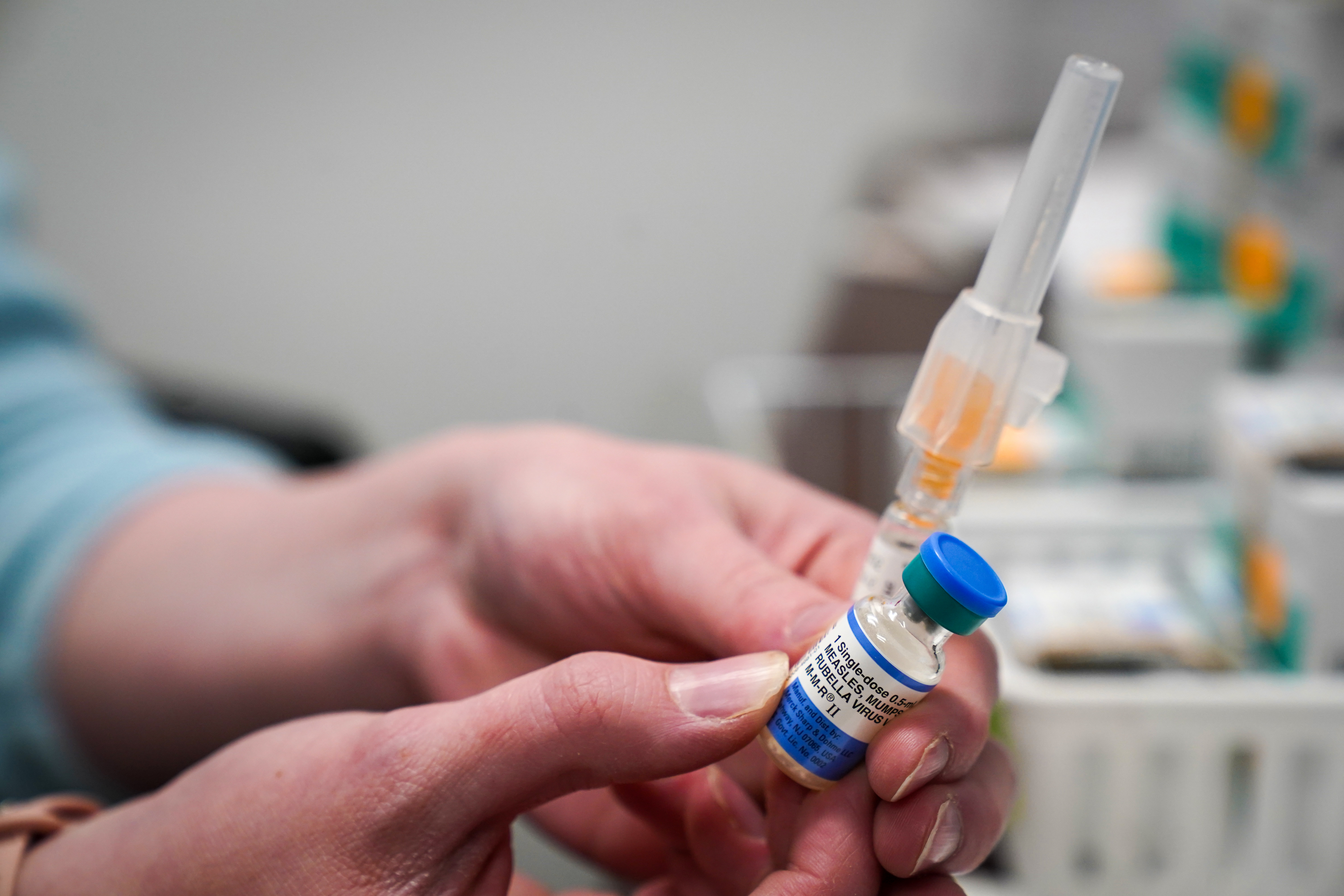
With vaccination rates plummeting in Pennsylvania schools and the nation on the verge of a massive measles outbreak, state health officials three years ago created a sweeping plan to drive up protections for thousands of children.
Armed with millions of federal dollars, they launched a statewide advertising campaign that touted vaccines as critical safeguards to fight disease.
The plan included television spots and images of beaming children on outdoor signs and social media posts — their arms thrust in the air — and the words: “Be proactive. Be well.”
But while Pennsylvania officials were trying to boost immunization rates, school districts statewide were sharing information with parents that was radically different from the advice of state experts.
At least 20 school systems from Pittsburgh to Philadelphia prominently posted a link to an extremist website with alarming messages about childhood vaccines: The shots can kill.
They cause autism. They can lead to diabetes. They trigger paralysis.
“Free your mind from the vaccine paradigm,” the site says.
Since at least 2018, that link was shared with tens of thousands of parents at a time measles cases were raging across the country and scores of children were hospitalized, a Post-Gazette investigation found.
The website, Vaclib.org, is part of an organization whose stated mission is to reveal “the myth that vaccines are necessary, safe and effective.”
It’s unclear why the school systems posted the link to claims that have been widely disputed by scientific research, but nearly all of them took down the post in recent months after being contacted by the Post-Gazette.
Half of the districts did not respond to multiple inquiries from reporters about the links, which were included on a form that parents can use to exempt their children from the shots.
Several superintendents and school officials reached by the Post-Gazette said they did not see the link on their websites and were surprised that it was provided to families from their schools.
“Without you reaching out, I don’t know if we would have found that,” Terry Struble, superintendent of the Clearfield Area School District in Clearfield County, wrote in an email.
Other districts in the Pittsburgh region providing the link include East Allegheny, Bethel Park and Plum Borough.
Hundreds sickened
The public display of the information comes as vaccination rates fall in schools statewide, leaving thousands of children vulnerable to diseases that were once considered to be eliminated.
The Post-Gazette found in a six-month investigation published last month that rates in one in every four elementary schools have plunged below herd immunity — the threshold needed to stop the spread of the disease.
This year alone, more than 30 measles cases have been reported in the state — the most since 1991 – in some of the same counties where school vaccine rates have fallen.
Officials of the Pennsylvania Department of Health, which sets standards for school immunization, said they were unaware the districts had posted the link, even though the agency collects all vaccination data from 4,500 schools — public and private.
A spokesperson for the Pennsylvania Department of Education said the state agencies are not responsible for what school districts put on their websites, including information about vaccines.
But a special state commission put both departments on notice a decade ago that vaccine monitoring and enforcement is shared by both agencies along with the districts.
The special panel urged the departments in a 2016 report to create clear rules on how the enforcement system could better work, but that task was never carried out.
“Unacceptable,” said state Rep. Michael Schlossberg, D-Allentown, who has long supported immunization protections. “It’s unacceptable to have any body of government sending people at any site that’s not actually supported by science.”
While 20 different districts were displaying the links, the vaccination rates of kindergarteners in those schools began falling in 2020, in some cases to levels that had not been seen in years, the Post-Gazette found.
One in every three elementary schools in those districts is now below herd immunity — 19 in all — the threshold of safety needed to fend off measles, the data shows.
Just six years ago, nearly all of them were above the threshold.
Experts say there’s no way to measure the impact of the information provided to parents, but a host of studies show that massive social media campaigns critical of vaccines during the pandemic had a direct correlation to the decline in vaccination rates.
Critics of the shots say organizations have a right to challenge the safety of vaccines and that they pose greater risks to students than the diseases.
Those opposed to vaccine mandates continue to promote what they call natural immunity as a more effective way to fight illnesses.
“You’re putting something foreign in your body,” said Ingri Cassel, whose family founded Vaccination Liberation, the website that was linked to the school district websites.
She said she did not know her site was provided by the districts, but added, “They should all be looking at the information.”
Dorit Reiss, a professor at the University of California College of the Law, San Francisco, who studies vaccine laws, said scientific research over the years — including studies involving millions of participants — found no correlation to autism and other disorders.
She said she was “horrified” that links to the website were placed on documents that school systems share with parents. In all, the districts included 105 schools.
In one of the images on the site, a baby is crying — with six needles injected into the tiny body — and seen next to the words, “Autism,” “Diabetes,” “Allergies,” and “Seizures.”
In another, a poster is emblazoned with the words, Shots Can Hurt, while listing more than a dozen supposed injuries: paralysis, asthma, encephalitis and even death.
Tracking the misinformation
To track down the school districts that provided the links, the Post-Gazette reviewed the websites of every school district in Pennsylvania — 500 in all.
In addition to the school systems showing the links, the Post-Gazette found that two charter schools and a private institution were including the same information on their websites.
So far, only one, the Y.A.L.E School Pennsylvania, a private school for students with disabilities in Philadelphia, had not removed it. The school did not return repeated calls for interview requests.
Because the districts that responded to the Post-Gazette’s inquiries said they didn’t know how the links ended up on their websites, reporters began tracking the digital information.
Every online document contains hidden identifying data — an electronic fingerprint — that records details such as when it was created and what software was used to make it.
By analyzing this data, the Post-Gazette was able to find that a school district in Montgomery County — Upper Perkiomen — appeared to be the first to put out this information on its site.
The data shows the district created a basic form in 2018 about the state’s vaccine laws — including exemptions that parents can seek for their children to avoid the shots.
Embedded in the form was a link “for more information,” which then directs the parent to the anti-vaccination site.
One by one, other school districts began copying the form and pushing it out to their own sites — and sharing the link with thousands of additional parents.
What’s not clear is whether some district officials knowingly included the links on their sites.
Alexis Jenofsky, a spokeswoman for Upper Perkiomen, said the district conducted a review after it was contacted by the Post-Gazette in December. It found that the document was not created by the district and “appears to have been shared historically as a template among Pennsylvania school districts.”
“The District does not endorse vaccine misinformation and remains fully committed to meeting Pennsylvania’s immunization requirements,” she said.
Records examined by the Post-Gazette clearly show that the earliest form originated with Upper Perkiomen on March 28, 2018 — and carried a distinct document identifying number.
That same number appears on at least 11 other forms subsequently put out by school districts linking to the same site, created by Vaccination Liberation, which was founded in Idaho by Cassel’s mother and helped push for successful legislation last year that bans schools in the state from requiring the shots.
Shortly after the Post-Gazette notified the district of the link, it was removed. Other districts took the same step after they were alerted to the link by Post-Gazette reporters.
In Allentown, the information was taken down a day later.
“Upon review of the form you referenced, we have removed this document from our website,” wrote Melissa Reese, communications manager for the district.
Lack of oversight
Chad Hermann, a former communications professor at Carnegie Mellon University who studies vaccine messaging, said information can sometimes be overlooked on a crowded website.
But when it’s displayed for years on the same site, it raises questions about the role of district leaders in ensuring that information their school systems provide is carefully screened for accuracy, he said.
“It instantly makes me question both the authority and the credibility of anyone at that district who was overseeing that sort of thing,” he said, adding that “there’s a standard of responsibility for the information that they provide to their families and their students.”
The school districts that displayed the links stretched across the state, from East Allegheny to Penn-Delco outside of Philadelphia.
Jim Cromie, a spokesman for the Bethel Park School District, said he and others were confused that the insert was on their site.
“I can tell you that we would never intentionally mislead our families or include incorrect or debunked information,” he wrote in an email in December.
In a recent interview, he said the discovery of the link sent him into overdrive. “I spent a good part of our winter break making sure there weren’t other links like that on our website,” he said.
Reiss, the California law professor, said the open display of the links underscores a more fundamental problem in Pennsylvania: the lack of oversight by any state agency.
Unlike states such as California, each individual school system in Pennsylvania is responsible for policing itself when it comes to vaccine safety — including the information it provides to parents.
Hermann says that’s what’s troubling about the links that were embedded on the official school websites.
“There’s an absolute implication that if a school district is sharing information with you, that it is factually credible,” Hermann said. “If that website is shared by the institution that provides education to my children — my community — it absolutely adds credibility. It’s not the same as just stumbling upon it on the internet.”
After years of tracking groups that challenge the safety of vaccines, he said one of his biggest concerns about the information on the websites is the impact it may have had on parents enrolling their children in schools for the first time.
“Bad health information — particularly health information — is scary,” he said.
Holly Verderame, president of the Pennsylvania Association of School Nurses and Practitioners, said she was surprised after learning from the Post-Gazette about the information spread by the districts.
“It’s what we as school nurses spend hours trying to debunk,” she said.
The Post-Gazette found that the school websites were showcasing the links while the state health department launched a $5 million ad campaign in 2023 to push immunizations on TV ads, radio, digital and outdoor images.
By the time the campaign ended last year, the ads generated 126 million impressions, the health department said.
But in the classrooms, the immunization rates continued to fall.
A lack of enforcement of the state’s vaccine laws played a key role in the decline.
With the districts left to handle their own enforcement, school leaders allowed thousands of children into classrooms over the last two years without the shots or the legal exemptions, the Post-Gazette found.
A decentralized program also means districts use their own information rather than a single, authoritative source explaining to parents about the shots.
“You’re going to get dozens if not hundreds of different messages,” said Hermann. “It was probably someone saying, ‘Hey, here’s a resource you can use.’ And then there’s this backdoor that leads to that anti-vax site. That’s incredible — incredible way to do your homework.”
Deputy Managing Editor for Investigations Michael D. Sallah and Associate Managing Editor for Data Investigations Mike Wereschagin contributed to this report.